
The Flight Ahead: Supporting the White Bird’s Return to the Skies
Powered by partnership.
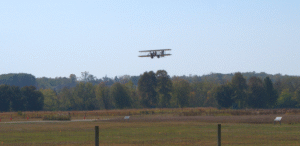
The White Bird in flight over Huffman Prairie Flying Field. Photograph courtesy of Wright “B” Flyer.
If you have never visited the Wright “B” Flyer, Inc hangar and museum, you might be surprised to find it’s much more than a collection of antique aviation artifacts. While the site does feature fascinating displays, like the Valentine Flyer, a close replica of a Wright Model B that was used in a 1978 Wright Brothers movie, to fascinating early aviation ephemera, and even a working Model T Ford, what truly sets Wright “ ” Flyer apart is its mission to keep history flying. The organization operates two airworthy “look-alike” aircraft modelled after Wright Model B Flyers, affectionately known as “Brown Bird” and the “White Bird.” The White Bird itself isn’t just a statis exhibit piece; it quite literally takes to the skies at special events, giving spectators a chance to marvel over what the Wright brothers’ early flights looked like. Powered by a dedicated, all-volunteer team of pilots, engineers, mechanics, and aviation enthusiasts, Wright “B” Flyer is both a museum and a living tribute to the Wright brothers’ pioneering legacy. Special Events Coordinator, Steve Donaldson, asserts that the importance of the organization is in “the idea that Daytonians, and now people all over the world, can see what a Model B looked like flying and truly understand what the Wright brothers did.” Over the past two years, the National Aviation Heritage Area has proudly supported Wright “B” Flyer’s unique mission through two major grants, helping the organization keep the White Bird in the air, as well as Dayton’s aviation legacy alive.
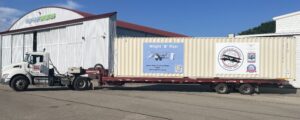
Wright “B” Flyer’s shipping container, now used to safely transport the White Bird to airshows, including AirVenture in OshKosh, Wisconsin.
In 2024, Wright “B” Flyer received a grant from NAHA’s inaugural Large Grant program to tackle a major logistical and outreach challenge: transporting the White Bird to Oshkosh, Wisconsin for EAA AirVenture. According to Donaldson, “the importance of the Oshkosh airshow can’t be understated. AirVenture is the Super Bowl of airshows… the most well-attended airshow in the world, with over 600,000 people attending every year. Having the White Bird in attendance] really highlights the Wright brothers and Ohio and Dayton craftsmanship to the world.” Although the team had a shipping container, also funded by NAHA for transporting the aircraft to events, it lacked the necessary loading cards, bracing, air compressors, tools, and dunnage to safely secure the plane. That is where NAHA’s Large Grant program came in, funding the specialized equipment needed to outfit the container so it could safely move the White Bird. “Without NAHA, we simply would not have gone [to AirVenture],” Donaldson said. “With their support, we now have the infrastructure to take the White Bird to other locations, too. We used our Large Grant to outfit our shipping container and purchase dollies, tools, straps, and shipping supplies that we used to get the White Bird into the container and be able to ship it safely.”
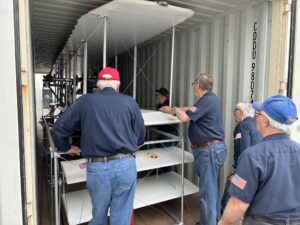
Wright “B” Flyer volunteers loading the White bird into the newly equipped shipping container. Photograph courtesy of Wright “B” Flyer.
With the new equipment in place, Wright “B” Flyer volunteers successfully built custom carts, braces, and tools to load the aircraft into the container. They added protective dunnage to prevent damage to the aircraft while in transit and wrapped the exterior with vinyl graphics showcasing Wright “B” Flyer, America 250 Ohio, Ohio Air and Space Trail, and NAHA imagery, effectively turning the container itself into a rolling advertisement for Dayton’s rich aviation heritage. Once in Wisconsin, volunteers reassembled the White Bird for display at AirVenture. While the aircraft remained on static display throughout the event, the team of volunteers who built, fly, and maintain it were on hand to answer questions and share Wright B’s story with thousands of visitors. Donaldson said the most common response to the White Bird at Oshkosh was amazement, with the visitors “asking ‘do you really fly in this thing? Are you insane?’…and the answer we gave is yes- we fly it all the time, just like the Wright Brothers did!” The Wright “B” Flyer team also handed out printed materials and posted signage with information about the aircraft, NAHA, and the abundance of aviation heritage sites found in Southwest Ohio. At the end of the show, the White Bird was packed up and brought safely home to Dayton, proving that the system worked as designed and could now be used to ship the aircraft to anywhere in the world.
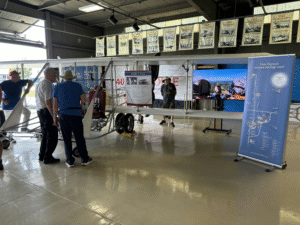
The White Bird on display at AirVenture. Photograph courtesy of Wright “B” Flyer volunteers.
Just a few months after the successful AirVenture visit, a new challenge arose for Wright “B” Flyer. On October 11, 2024, during a flight demonstration celebrating the 97th anniversary of Wright Field at Wright-Patterson Air Force Base, the White Bird experienced a serious in-flight malfunction. “We were doing a final flyover when there was an incident that caused the engines to rev up and the pilots had to make an emergency landing,” recalled Don Adams, the President of Wright “B” Flyer. “I was there watching and…with the smoke coming out [of the aircraft] it was a little scary at the time. But everyone was safe. The pilots did an amazing job getting it down.” Although no one was injured, the damage to the White Bird was significant. The engine was destroyed, and several other components were damaged, rendering the aircraft . It was a devastating blow for the team, who had poured thousands of hours into building, maintaining, and flying the White Bird. This came at an especially bad time for the organization. According to Adams “in 2024, we were really up and about. We flew [the White Bird] in a lot of different activities, parades, things like that. And we were going to ramp up even more in 2025 until this incident happened and curtailed all our plans.”
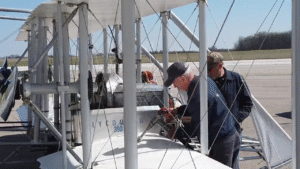
Wright “B” Flyer volunteers at work on the White Bird. Photograph courtesy of Wright “B” Flyer.
This could have been the end of the White Bird. Instead, it became the beginning of a new phase for Wright “B” Flyer, one focused on rebuilding. With support from a 2025 NAHA Large Grant, Wright “B” volunteers are now hard at work restoring the White Bird. The project is not a simple repair job. It entails a full damage assessment, rigorous safety evaluation, and structural and mechanical restoration work that will result in a fully restored, flight-ready aircraft. “The Large Grant we received from NAHA has helped a lot in us being able to do the things we need to be able to do to get the White Bird airworthy. The different testing we have to do… it’s just amazing how many things you have to go through. Each individual item must be tested not just once but three or four times,” explained Adams. The Wright “B” Flyer team is also using the grant to update their internal safety protocols, ensuring they follow the Federal Aviation Administration’s standards for historic aircraft. Likewise, they will document findings from the damage assessment and make them available for review by restoration engineers and safety professionals, further ensuring the safety of the rebuilt White Bird. Finally, the project will end with a public unveiling and demonstration flight to celebrate the aircraft’s triumphant return to the skies.
From reaching new audiences to recovering from unexpected setbacks, Wright “B” Flyer has stayed focused on its mission despite an eventful and difficult year. For Don Adams, the heart of Wright “B” Flyer’s work is honoring the Wright brothers’ legacy: “to maintain Ohio’s aviation heritage, we need to maintain the Wright Brothers’ heritage. And that’s a passion for all of us that are here. All of us here are volunteers- none of us get paid for what we do because we have a passion for preserving that family name. The Wright Brothers’ invention is an invention that changed the world. I mean it literally changed the world.”
These two grants tell a story that goes beyond parts, tools, and logistics. They demonstrate what our region’s incredible aviation heritage organizations can accomplish with NAHA’s support, and why the continuation of the National Heritage Area program is so vital for this region. For Adams and Wright “B” Flyer, NAHA is not just a partner but an integral piece of the organization’s puzzle: “I don’t think that we could stay in existence without NAHA and the federal funding that comes with it. We have the NAHA Non-Competitive Grant every year that we get to use for projects. And we have the opportunity to apply for Large Grants, which allows us to expand our footprint not only in Dayton but also around the world. We depend greatly on NAHA.” Adams also emphasized how NAHA helps aviation organizations across Southwest Ohio lift one another up: “NAHA’s ability to pull together all the different facets of aviation in our area and allow us to work together and utilize each other’s talents… it’s a huge benefit to our area and this part of the continental United States. We always recommend when people come to our museum that they visit others in the region- not just for the Wilbears, but to see what else is here. Because we have a rich history, and it can’t all be housed in one facility. It’s housed in at least eighteen different facilities, each with a different story to tell.”
Wright B’s journey, and the White Bird’s return to the skies, remind us that preserving our aviation history takes more than passion- it takes resources and partnership. And with the National Aviation Heritage Area’s continued presence and federal support, these stories will keep soaring for generations to come.