During World War II, Montgomery County’s wartime contracts exceeded $1.645 billion, fueling economic growth. By 1940, the county had over 500 factories producing 1,000+ products, including automobiles, aviation parts, and engineering equipment. By 1943, 60 were classified as war production facilities. NCR’s workforce grew from 8,000 in 1940 to 20,000 in 1945. Dayton’s factories operated 24/7, employing increasing numbers of women (50% of the workforce by 1945) and African Americans migrating from the South. In 1942, the city needed 50,000 more workers, leading to the creation of the Dayton War Manpower Committee. Dayton businesses, including NCR and Frigidaire, earned multiple Army-Navy “E” Awards for excellence. The city was considered a key target due to its critical role in the war effort.
Inland Manufacturing, a division of General Motors, converted its west Dayton plant—originally built for the Wright brothers’ company—to produce armaments, including nearly 50% of the M1 carbines used in the war. Part of this site is now being acquired by the National Park Service.
Delco, founded by Charles Kettering and Edward Deeds, manufactured essential military components at its various plants, including tank tracks, airplane parts, and ammunition. It earned an Army-Navy “E” Award for its contributions.
Huffman Manufacturing produced over 4,000 military bicycles, including a folding model for paratroopers, though few were used in combat.
Frigidaire, another GM division, shifted from appliances to weaponry, employing 16,000 workers to produce over 360,000 .50 caliber machine guns and one million spare barrels. Engineers reduced costs significantly and contributed to aircraft propeller production, long-range fuel tanks for the Doolittle Raiders’ B-25s, and other critical wartime components.
Aeroproducts, a GM division in Vandalia, assembled propellers for Bell P-39 and P-63 fighters, using parts from Frigidaire factories.
National Cash Register (NCR) contributed beyond code-breaking by producing bomb sights, shell fuses, and plane engines.
Standard Register shifted from business forms to supplying order and supply documents for munitions and troop logistics. It also manufactured wooden registers to conserve metal and produced wooden carbine rifle parts for Inland Manufacturing, earning multiple wartime citations.
McCall Printing Company – 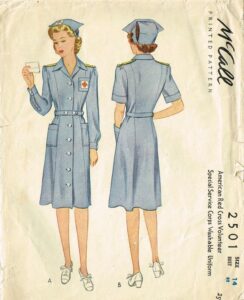 During World War II, McCall’s sewing patterns were printed in the City of Dayton. For example, Red Cross Volunteer Special Service Corps patterns which dictated colors, fabric type and usage. Of note, Japanese Americans held in detention camps were relocated to Dayton and welcomed by the printing union to work at McCall’s
Reynolds and Reynolds Company – Reynolds and Reynolds printed ration books and became the lead printer of technical handbooks for Wright Field and Patterson Field Army Air Services.
Mead Paper Corporation – A $40 million paper and container company, Mead Corporation made containers for domestic and Allied forces working within wartime price and profit controls, as well as raw material shortages.
The Dayton Rubber (Manufacturing) Company – This company made significant contributions to the war effort by producing bogie tires for tanks and a light-weight, non-collapsible life-giving oxygen hose able to withstand extreme temperature ranges. This Dayton company also operated a plant outside of Montgomery County that produced pontoons and life rafts. For their efforts, both plants received the Army-Navy “E” Awards. The company was later known as Dayco.